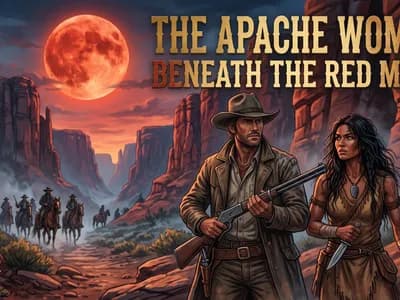
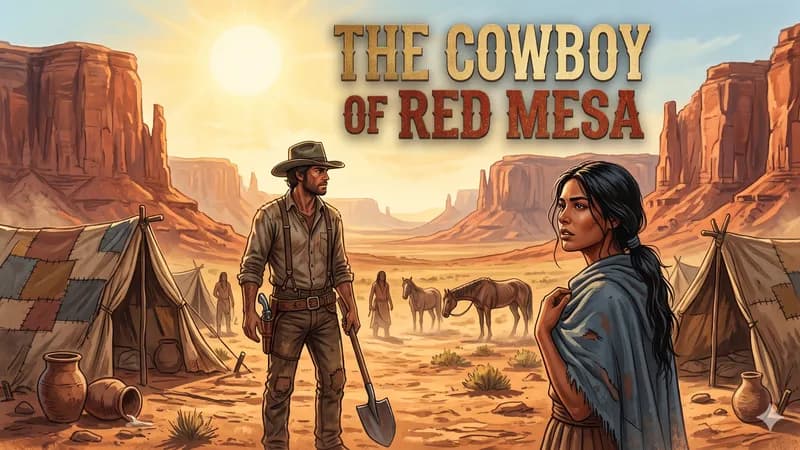
A Lonely Cowboy Found 23 Apache Women Dying of Thirst—What He Discovered Beneath the Desert Changed Their Lives Forever
Chapter 1 • Part 1/9 • ⏱ 4 min • 👁 1 • 22/11/2026
The horse stopped where the wagon road vanished into red dust. Nathan Cole did not blame her. For two days the country had offered nothing but thornbrush, stone, and the illusion of water trembling above the flats.
Theme
Font size19px
Chapter 1
The horse stopped where the wagon road vanished into red dust. Nathan Cole did not blame her. For two days the country had offered nothing but thornbrush, stone, and the illusion of water trembling above the flats. He lifted his hat, studied a circling hawk, and tried to remember whether his father had ever mentioned this stretch of Arizona.
Before the riders came, Nathan walked through the camp with Elena and learned the names of the people he had been thinking of as a single desperate crowd. Rosa repaired saddles and could tell the age of a horse by its teeth. Old Lucia kept a garden of seeds wrapped in cloth, saving them through each failed season because she believed there would be rain again. A boy named Tomas carried water to the horses before drinking himself. Each name made the danger more particular. Nathan had seen ranches fail before; he had never understood how many small acts were required to keep a community alive when the land turned against it. Elena told him that people who came with papers rarely stayed long enough to learn those names. He promised himself he would not make the same mistake.
His father had taught him to look for green where green had no business being. A cottonwood could tell a man more than a map. So could the flight of doves at evening, or a cold seam in a rock after the sun had climbed. Those lessons were all Nathan had inherited. The ranch itself had been taken when he was seventeen, after a judge signed a paper that nobody in the family had been allowed to read.
He had spent twelve years drifting between cattle outfits, telling himself he wanted nothing more than wages and an open trail. Now, with a nearly empty canteen and a lame horse, he wondered whether drifting was merely a respectable name for running away.
He saw the birds first. They lifted from a ravine ahead, a scattered cloud of brown wings. Below them lay a cluster of shelters tucked into the shade of a sandstone wall. Nathan rode closer and discovered that the camp had been watching him long before he saw it.
Three riders emerged from the rocks. The youngest leveled a rifle; the oldest kept his weapon pointed at the ground. Nathan raised his hands and said he was looking for water. The older man answered in careful English that there was none.
Nathan could see that. Clay vessels stood empty near the shelters. A child sat beside one with his head resting on his mother's knee. The horses were lean, and the women moved with the weary economy of people who had learned to conserve every step. These were Apache families, not the raiders described in the stories Nathan had heard around saloon tables. They were people trying to keep children alive.
He handed over his remaining canteen. The older rider accepted it reluctantly and passed it to a woman without drinking. That small gesture changed something in Nathan. He had expected suspicion; he had not expected such careful generosity from people with so little to spare.
A woman in a blue shawl approached. She was younger than the older rider, with a steady gaze and dust on her hands. She introduced herself as Elena, then indicated the elderly man standing behind her. His name was Mateo. He had guided these families to the ravine when their usual spring failed.
'Failed how?' Nathan asked.
'It stopped,' Elena said. 'Three months ago. One morning there was water. The next there was mud. After that, nothing.'
Nathan looked toward the northern escarpment. A dark line of cottonwoods ran beneath the cliff, their crowns sparse but still alive. He asked permission to inspect the ground. Elena exchanged a glance with Mateo. The young rifleman laughed openly.
'You think you can find a river with your eyes?' he asked.
'Not a river,' Nathan said. 'Maybe the place somebody stole it.'
The laughter ended. Mateo watched him for a long moment before offering a shovel and two men. He told Nathan that the camp could spare the labor until sunset, no longer. Nathan understood what the deadline meant. They could not afford to waste strength on a stranger's idea.
Elena walked beside him toward the cottonwoods. She said her father had once taught her that the earth remembered every footstep. Nathan answered that his father had believed the earth remembered water as well. For the first time that day, she smiled.
At the base of the cliff, Nathan knelt and pushed his fingers into the soil. It was warm at the surface, cool below. Ants moved along a crack in the stone. Nearby, the roots of a mesquite tree had turned sharply uphill, seeking something hidden. He asked the men to dig.
The first hour brought nothing. The second uncovered a slab of fitted stone, too straight and smooth to be natural. Nathan scraped away the dirt, found the mouth of an old channel, and smelled dampness rising from the darkness beneath it. Someone had built this watercourse long before the present camp arrived.
He crawled forward far enough to touch the inside wall. The channel was dry, but its lime deposits were fresh. Water had passed through recently. He came out with mud on his sleeve and a conviction he could not yet prove.
'It didn't disappear,' he told Elena. 'Something upstream is holding it back.'
She looked at the stonework, then toward the northern ridge where strangers had been digging for weeks. 'If you're right,' she said, 'then someone decided we should die of thirst.'
Disclaimer: This story is a work of fiction created for entertainment purposes. Any resemblance to real people, events, organizations, or places is purely coincidental.
More in the same category
View more →