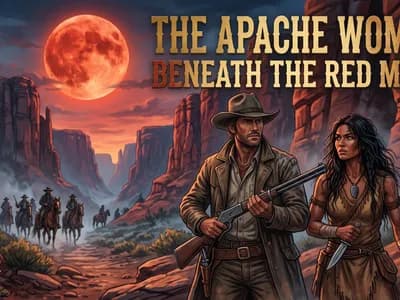
A Lonely Cowboy Found 23 Apache Women Dying of Thirst—What He Discovered Beneath the Desert Changed Their Lives Forever
Chapter 7 • Part 7/9 • ⏱ 4 min • 👁 1 • 22/11/2026
Theme
Font size19px
Chapter 7
The hearing began with the water diversion. The marshal presented the dam's timber marks, the shipment orders, and testimony from miners who had worked on the reservoir. Shaw authenticated the old agreement and explained the territorial register. Bell testified about Pike's payments and the threats that had kept the sheriff silent. Henry Vale, whose telegraph office had burned, identified the messages he had managed to transmit before the attack.
Elena spoke last. She did not describe her people as helpless victims. She described their work, their seasonal movements, their graves, their gardens, and the spring that had sustained them before the company diverted it. She described the empty jars and the children waiting for water. She asked the judge to consider what a claim of vacant land meant when made by a man who had forced its inhabitants to leave.
Ashford's lawyer objected repeatedly. The judge overruled him when Elena produced her grandfather's mark on the agreement and Shaw confirmed its registration. The lawyer then argued that old promises did not bind the present company. The judge replied that this question required formal review, but that the evidence of deliberate water diversion and intimidation was sufficient for immediate protective orders.
Nathan had hoped for a simple verdict that would restore everything at once. Instead, the judge ordered the reservoir gates opened, the company's claim suspended pending examination, and Ashford held on charges connected to the sheriff's murder and the fire. It was not the end of the struggle. It was the first time a court had forced Ashford to answer questions rather than ask them.
Outside, a crowd waited. Some cheered. Others muttered that the territory was being given away. Elena stood beside Mateo and refused to bow her head. Nathan saw children from the temporary camp peering around the adults, curious rather than frightened.
Ashford was led past them in irons. He stopped in front of Nathan. 'You think you've won your father's ranch back?' he asked. 'You haven't even learned what he did to lose it.'
Nathan felt the old anger rise. He took one step forward before Elena caught his sleeve. Ashford smiled, pleased to have struck a nerve, and was led away.
That evening Nathan opened the ledger again. He found a second entry under his father's name, written in a different hand. It referred to a survey made before Ashford's company existed. Andrew Cole had discovered that the northern watercourse crossed several ranches, not just his own. He had tried to organize a shared claim. Ashford's father had destroyed the effort by buying the judge.
Nathan closed the ledger. His father had not lost the ranch because he failed to understand the law. He had lost it because he tried to make the law protect his neighbors too. The realization did not erase the grief of twelve years, but it gave that grief a different shape.
Elena found him outside the courthouse, staring toward the hills. He told her what he had learned. She listened, then said, 'Your father was not asking you to spend your life chasing what was stolen. Maybe he wanted you to build what he could not.'
Nathan looked toward the road leading back to the valley. For the first time, it seemed less like a road away from his past than a road toward his future.
The valley did not turn green overnight. When the company gates were opened, water returned in fits and starts, muddy at first, then clear. The old stone channel had to be repaired before the stream could flow safely through the ravine. Nathan worked with Mateo's sons and the women who knew the irrigation beds. They rebuilt the banks with stone and willow branches, taking care not to send a flood through the shelters they had just raised.
The families decided where the water should go. Mateo called a council, and the elders invited representatives from nearby ranches whose wells had also been damaged. Nathan expected arguments. There were arguments, but they were about ditch widths, planting dates, and who would clear the silt after storms. They were arguments made by people planning to remain.
Elena proposed a common water schedule that would protect the spring's minimum flow before anyone diverted water to fields. Some ranchers protested that they had paid for their ditches. She answered that a dry spring could serve no one, no matter how much money had been spent on a gate. Nathan supported her with measurements from the old survey, but he let the council make its own decisions.
The territorial judge's final review took months. Ashford's claims were challenged parcel by parcel, and the old agreement was entered into the public record. Some stolen properties were returned; other families received compensation or new access rights. The court could not undo every wrong, and several cases remained unresolved. Still, the company no longer controlled the spring. The community gained recognized rights to maintain the channel and use the valley according to the agreement.
Nathan was offered a small tract near the southern bend. It had once belonged to his father, though little remained of the original ranch except a collapsed corral and a row of cottonwoods. He walked the boundary alone before accepting. At the far end, beneath a stone, he found the rusted horseshoe his father had nailed to a fencepost when Nathan was a boy.
He carried it back to camp. Elena was helping Rosa organize lumber for a new shelter. She asked what he had found, and he showed her the horseshoe. 'A piece of home,' he said.
'Will you go back there?'
'I think I'd rather build something here.'
She looked at him carefully. 'Here with us, or here because you think you owe us?'
Disclaimer: This story is a work of fiction created for entertainment purposes. Any resemblance to real people, events, organizations, or places is purely coincidental.
More in the same category
View more →