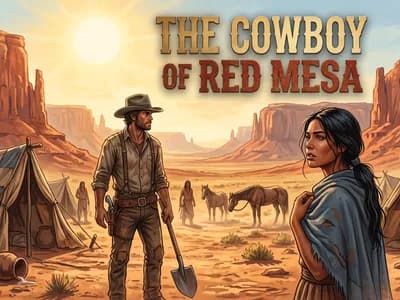
The Cowboy Married a Mysterious Apache Woman—But Her Dark Secret Would Change His Life Forever
Chapter 7 • Part 7/9 • ⏱ 5 min • 👁 2 • 22/11/2026
Theme
Font size19px
Chapter 7
The final ruling overturned several fraudulent claims and recognized the rights of surviving families to portions of the valley. Mara was entitled to land through her mother's family, including a share of the spring. Caleb learned that the western pasture his father had purchased years after the attack overlapped part of the disputed territory.
He studied the survey with a heavy heart. “The ranch may not survive without that water.”
Mara looked at him. “I know.”
He waited for her to offer an easy solution. She did not. Instead, they spent a week meeting families and listening to what they wanted. Some wished to return. Others needed access to water for livestock but had built homes elsewhere. Several wanted a place where their children could learn the history of their people without fear.
Caleb proposed a shared water agreement and offered to surrender the disputed acreage. The ranch would retain limited grazing access in exchange for maintaining the spring and the road. Mara helped draft the arrangement, but she insisted that the families themselves approve it. There would be no new bargain made over their heads.
The meetings were difficult. Some people distrusted Caleb because of his father's name. Others resented Mara for marrying a white rancher. She listened without demanding immediate forgiveness. Caleb learned to sit quietly through accusations that hurt because they contained truths he could not change.
At last an agreement was reached. A community council would oversee the spring and the restored land. Families could return, share grazing routes, and maintain the old burial ground. Mercer Ranch would become a partner rather than an owner of everything the valley needed.
When the papers were signed, Caleb felt both loss and relief. He had given up something he once believed essential. Yet the ranch seemed less fragile now that its future rested on cooperation instead of possession.
That winter Mara received a letter from a woman named Ruth in the southern mountains. Gideon Price had told her of the hearing, and she had recognized Sani's name. Ruth wrote that Sani had lived with her family during her final illness. She had died six years earlier, but not alone. She had left a scarf, several stories, and a message for the daughter she hoped would someday find her.
Caleb wanted to accompany Mara south. “You don't have to,” she told him.
“I know.”
“This journey may be painful.”
“Then you shouldn't have to make it alone unless you want to.”
She took his hand. “Come with me.”
They traveled through cold rain and high mountain passes until they reached Ruth's small settlement. Ruth was elderly, with gentle eyes and hands worn by years of work. She welcomed Mara as though she had been expected for a very long time.
From a cedar chest she brought a blue-and-brown scarf woven with careful patterns. Mara recognized the colors immediately. Her mother had worn a similar scarf when she was young. Ruth explained that Sani had spent her later years helping displaced families find shelter and teaching children songs and stories she feared would otherwise be forgotten.
“She spoke of you every day,” Ruth said. “She worried you would believe she had abandoned you.”
Mara pressed the scarf against her face. “I did believe it, sometimes.”
“She left because men were still searching for her. She thought distance would keep you safe. Whether she was right, I cannot say. But she loved you.”
Ruth gave Mara a final letter. Sani had written that she hoped her daughter would seek justice without allowing hatred to become her whole life. She wanted Mara to build a home, laugh freely, and remember that belonging was something people created together.
Mara cried for the years they had lost. Caleb stayed beside her, neither interrupting nor offering explanations that could not heal the wound. The next morning they visited Sani's grave beneath a cedar tree. Mara placed a small stone there and told her mother about the restored land, the families returning to Red Mesa, and the man who had helped her find the truth.
On the ride home, Mara said quietly, “I thought finding the truth would end my grief.”
“Did it?”
“No. But it changed it. I can remember her without only remembering what was taken.”
Caleb nodded. “Perhaps that's what peace is.”
THE BRIDE WHO CAME TO RED WILLOW
CHAPTER TEN — THE PRICE OF A NEW FUTURE
Spring brought new grass and new trouble. A railroad survey crossed the eastern valley, and a businessman named Harrison Voss began buying ranches along the proposed route. He offered generous prices at first. When owners refused, he bought their debts, challenged their boundaries, and persuaded merchants to deny them credit.
Voss arrived at Mercer Ranch in a polished carriage, wearing gloves too clean for the country. He spoke pleasantly about progress and prosperity. “The railroad will transform Red Willow,” he said. “You would be wise to sell before the opportunity passes.”
Caleb declined. Mara asked whether the proposed route would affect the shared spring. Voss smiled. “The company will make whatever arrangements are necessary.”
“That isn't an answer,” she said.
“It is the only one you require.”
After he left, Caleb spread the survey map across the kitchen table. The line ran dangerously close to Red Mesa. If Voss controlled the neighboring parcels, he could restrict access to the restored land without ever challenging the court's ruling.
Mara called a meeting of ranchers, farmers, and community representatives. They agreed to form a cooperative to purchase supplies together, negotiate freight terms, and resist attempts to isolate individual landowners. Some feared Voss's influence. Others doubted that people with such different histories could work together.
Caleb stood before them in the schoolroom and spoke simply. “I used to think protecting my land meant standing alone with a rifle. I was wrong. The people who helped rebuild my barn did more for this ranch than I could have done by myself. If we let Voss separate us, he'll take every piece he wants.”
Disclaimer: This story is a work of fiction created for entertainment purposes. Any resemblance to real people, events, organizations, or places is purely coincidental.
More in the same category
View more →