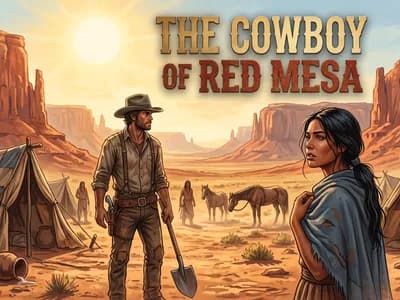
A Cowboy Saved a Wounded Apache Woman in the Desert—But the Secret She Carried Could Destroy an Entire Town
Chapter 5 • Part 5/9 • ⏱ 4 min • 👁 0 • 22/11/2026
Theme
Font size19px
Chapter 5
Gabriel had once believed that keeping his head down was the safest way to live. He now understood that silence could be a kind of permission.
“Then we go to Red Mesa,” he said. “And we tell everyone.”
Red Mesa had once been a noisy trading town where mule wagons crowded the square and children chased one another between the blacksmith's shop and the bakery. When Gabriel, Talia, and Jonah reached it the following evening, the streets were nearly empty. The general store had shutters over its windows. Two armed men stood outside the jail. The telegraph office flew a company flag.
At the livery stable, a boy named Peter recognized Gabriel and pulled him into the shadows. His father, a printer who had questioned Harrow's land purchases, had been arrested. So had the schoolteacher and three ranchers who refused to sign over their wells. The sheriff had disappeared after attempting to intervene.
“Harrow says they are protecting the town from raiders,” Peter whispered. “He says Apache fighters are gathering in the mountains.”
Talia went very still. “He is making an excuse.”
“For what?” Jonah asked.
“To bring soldiers. If he calls us a threat, they will clear the valley for him.”
Gabriel remembered a village he had passed during his army service, burned after a false report of an attack. He had obeyed orders that day and spent years remembering the people who had fled. He would not let another lie travel unchallenged.
They found shelter in Doctor Bell's surgery. She stitched Jonah's arm and told them the sheriff, Miriam Sloane, was being held in her own jail. Harrow had replaced the deputies with company guards, including Pike. Doctor Bell had kept a list of witnesses who saw the arrests and could identify the men involved.
“We need more than a list,” Gabriel said. “We need the telegraph.”
“And the prisoners,” Talia added.
The plan depended on everyone doing something dangerous. Doctor Bell would summon townspeople to the church under the pretense of a medical meeting. Peter would carry a note to the stationmaster, whose son had been jailed. Jonah would distract the guards near the stables while Gabriel entered the jail through a coal chute. Talia would reach the telegraph office with evidence from Nathaniel's survey and Jonah's work order.
“You should stay here,” Gabriel told her.
She regarded him coldly. “You have mistaken an injury for an inability to choose.”
He apologized. She accepted without smiling, but when he offered his hand before they separated, she took it.
At midnight, Jonah overturned a cart in the stable yard and set the mules loose. The guards rushed toward the commotion. Gabriel slipped through the coal chute, dropped into a cellar, and climbed to the corridor behind the cells. Sheriff Sloane sat inside one, her hands bruised but her eyes sharp.
“I was beginning to think nobody would come,” she said.
Gabriel found the keys on a hook and freed the prisoners. Sloane took back her revolver from the desk drawer. Together they disarmed the remaining guard and opened the jail doors. Outside, people were gathering in the square, carrying lanterns and demanding answers.
Talia reached the telegraph office to find Pike standing over the operator. A half-finished message lay beside the machine, reporting that armed Apache bands had attacked settlers near the spring. Pike reached for his pistol. Talia drew first, aiming at the wall beside him.
“Step away,” she said.
Pike laughed. “You think they will believe you?”
“I think they will believe a signed message from the sheriff.”
Sheriff Sloane entered behind her. “Then we had better send one.”
Pike turned, saw the badge on Sloane's coat, and surrendered only when Gabriel appeared with a rifle. The operator sent a correction to the territorial command, naming Harrow's false report and requesting an investigation. But the first message had gone out hours earlier. The correction might arrive too late.
Harrow himself escaped through the rear of the freight office. Before leaving, he ordered two guards to torch the printing shop. Townspeople formed a bucket line and saved the building, though its presses were damaged. Peter found his father among the freed prisoners and held him so tightly that the older man could barely breathe.
Gabriel stood beside Talia as dawn spread over the square. They had freed the town, but the approaching soldiers would still have to be stopped. And somewhere in the hills, Harrow retained men willing to shoot first.
“We go to my family,” Talia said.
Gabriel nodded. “And we bring the sheriff.”
“Not as a shield,” Talia warned.
“No. As a witness.”
Talia led them into the high country along a route that avoided the army road. The journey took all night. Gabriel rode beside Sheriff Sloane, who admitted that she had suspected Harrow for years but lacked evidence strong enough to survive his influence in court. She did not ask for forgiveness. She promised to testify.
At sunrise they reached a settlement tucked between cottonwoods and a rocky slope. Children carried water from a narrow creek. Women tended cooking fires, and several men stood watch along the ridge. When they saw Gabriel and the sheriff, they raised their weapons. Talia dismounted before anyone could speak.
An older woman came forward, her face lined by sun and years. Talia embraced her and held on longer than Gabriel expected. The woman was her grandmother, Inez, who had raised her after Ashen disappeared. Inez listened while Talia explained the spring, the blasts, and Harrow's message to the army. She looked toward Gabriel.
“This man brought you home,” she said in English.
“He helped me find the way,” Talia answered. “But I chose it.”
Disclaimer: This story is a work of fiction created for entertainment purposes. Any resemblance to real people, events, organizations, or places is purely coincidental.
More in the same category
View more →