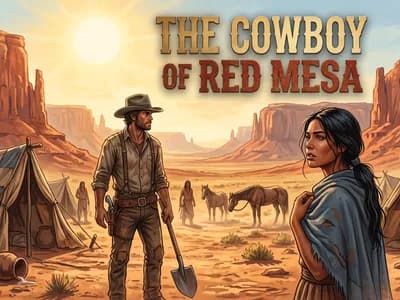
A Cowboy Saved a Wounded Apache Woman in the Desert—But the Secret She Carried Could Destroy an Entire Town
Chapter 8 • Part 8/9 • ⏱ 4 min • 👁 0 • 22/11/2026
Theme
Font size19px
Chapter 8
He smiled with relief. She laughed at his expression and kissed him beneath the willow, where the water kept moving even as the first snow began to fall.
Spring brought grass to the hills and a difficult abundance of work. Gabriel rebuilt the hay shed with Mateo, repaired the eastern fence, and planted a small garden because Talia said a home ought to grow something besides cattle. She traveled between the ranch and the settlement, sometimes staying several days, sometimes leaving before sunrise to attend council meetings. Their arrangement puzzled neighbors who expected a simpler story. Gabriel stopped trying to explain it to people who did not intend to understand.
One afternoon, a boy arrived with a wrapped bundle. He had come from a distant trading post where an old miner had kept a box of Nathaniel's possessions. Inside were a brass compass, a photograph of the two brothers standing beside their father, and a letter Nathaniel had written but never mailed.
Gabriel read it alone at the kitchen table. Nathaniel had known that Harrow's men were watching him. He had written about his fear, his mistakes, and his hope that Gabriel would someday understand why he refused the company's offer. He had also written a line that made Gabriel set the paper down and cover his face: I have spent too many years believing courage means never being afraid. Now I think it means knowing exactly what you may lose and doing the right thing anyway.
Talia found him there at dusk. He showed her the letter, and they sat together without trying to make grief disappear. Later they placed Nathaniel's compass on the mantel, not as a relic of a perfect man but as a reminder of a difficult choice made well.
The next year, Gabriel and Talia married in a small gathering beneath the cottonwoods. Her grandmother stood beside her. Mateo stood beside Gabriel and cried so openly that the children giggled. Sheriff Sloane attended without a uniform, and Jonah brought his new wife and their infant son. There was music, roasted corn, and a long argument about whether Gabriel had ever been a good dancer. He proved the critics right and danced anyway.
Their first years were not free of hardship. Drought returned one summer. A cattle sickness took six animals. A council dispute over grazing lasted longer than anyone wanted. Once, an ambitious investor offered to finance a road through the protected valley, promising that it would bring prosperity. Talia and the council rejected the route after careful study, proposing a safer road around the outer ridge. Gabriel helped survey it. The compromise cost more and took longer, but it preserved the spring.
They had a daughter, whom they named Mara after Talia's grandmother's sister, and later a son, Samuel, in memory of Gabriel's brother's given name. The children grew up hearing stories from both sides of their family. They learned to ride and to mend harnesses, to recognize plants, to ask permission before entering places held sacred by others, and to understand that a document could protect a right only when people were willing to honor it.
Gabriel sometimes rode alone into the desert. He no longer went to escape his life. He went because the country was wide and beautiful, and because returning home had become the best part of every journey.
One summer evening, Mara asked why he had brought her mother home when she was a stranger.
“She was hurt,” Gabriel said.
“That is all?”
“At first.”
“And after?”
He looked toward Talia, who was teaching Samuel to braid a rope near the porch. “Afterward I learned that helping someone is not the same as knowing their story. I had to listen to discover who she was.”
Mara considered this. “And did she listen to you?”
“More patiently than I deserved.”
From the porch, Talia called, “I heard that.”
Gabriel smiled. “She hears everything.”
Fifteen years after Harrow's arrest, the valley was still imperfect. There were dry seasons when people argued over every bucket, and wet seasons when the stream flooded the lower fields. Young men sometimes forgot why the old restrictions existed and complained that the protected chambers were being wasted. Others came from distant towns with proposals that sounded reasonable until someone asked who would bear the cost if they failed.
Talia answered such questions by taking people to the creek. She showed them the willows that held the banks together, the small channels that carried water into gardens, and the places where the old stonework could be seen without disturbing it. She told them about her father, about Nathaniel, and about the families whose names were remembered in the valley. She did not describe the spring as a prize won from an enemy. She described it as a responsibility that had passed through many hands.
Gabriel had grown slower in the saddle. His hair was gray at the temples, and an old injury troubled him when rain approached. He had learned to let the children mend fences without correcting every knot. He still woke early, made coffee too strong, and checked the horizon whenever the wind changed.
One autumn, a retired soldier visited the ranch carrying a worn rifle case. He had served with Nathaniel briefly while surveying the northern mines. He explained that Nathaniel had given him the rifle for safekeeping, saying it should be returned when the spring was no longer in danger.
Gabriel opened the case and recognized the carved stock. His brother had made the marks with a pocketknife when they were boys. For a long time Gabriel held the weapon without speaking. Then he carried it to the small memorial they had built beside the cottonwood and laid it beneath the stone bearing Nathaniel's name.
Disclaimer: This story is a work of fiction created for entertainment purposes. Any resemblance to real people, events, organizations, or places is purely coincidental.
More in the same category
View more →