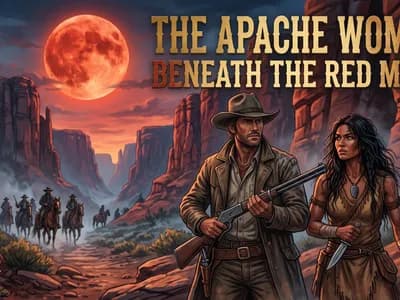
A Lonely Cowboy Freed an Apache Woman From Chains—But the Secret She Carried Could Destroy the Richest Man in Town
Chapter 5 • Part 5/9 • ⏱ 4 min • 👁 2 • 22/11/2026
Theme
Font size19px
Chapter 5
"And you do?" "Better than most." Caleb spoke. "Leave." Crowley laughed. "You don't understand either." He pulled a document from his coat.
"This ranch is mortgaged." Caleb's eyes narrowed. "Not anymore." Crowley smiled. "The debt was purchased yesterday." Mara looked at Caleb. He had no answer. Crowley continued. "You have seventy-two hours." "To do what?" "Leave." Caleb stepped down from the porch. Crowley leaned closer. "You can walk away rich." Caleb stared at him. "Or?" Crowley looked toward Mara. "Poor." Then he left. That evening, Caleb sat at the kitchen table. Mara noticed his hands were shaking. "How much do you owe?" "Everything." "How did he get the mortgage?" "My father borrowed money after the cattle disease." "And Crowley bought the debt." Caleb nodded. Mara placed the brass key on the table.
"We find the river." He looked at her. "And then?" "We expose him." Caleb smiled. "You sound like my wife." "What did she say?" "She said land means nothing if you let another man decide what it's worth." Mara smiled. "She was right." The next morning, they rode toward the northern canyon. Behind them, Crowley's men watched. Ahead of them waited the control chamber. And somewhere inside the mountain was the evidence that could destroy Crowley's empire.
The waterfall was scarcely more than a silver curtain over dark stone, fed by a spring that vanished beneath the cliff. Mara found it because the moss grew in a narrow arc instead of along the whole wall. Her father's map showed a passage behind that arc, and the measurements matched. Caleb secured the horses above the wash and carried the lantern inside. The air changed at once, becoming cold and mineral-scented. Water ran through channels cut into the rock by both nature and human hands. On one wall Mara found survey marks beside older carvings, evidence that people had known this water long before territorial officials arrived with their measuring chains. She traced the shapes without pretending she could explain every one. Her father had taught her that a map could be useful and still be incomplete. The stone door stood at the end of a passage barely wide enough for two people. The brass key turned with resistance. Beyond it, a dry chamber held sealed tins, rolled maps, and ledgers protected from damp by shelves raised above the floor. The place was not a treasure vault. It was an archive built by frightened men who believed truth might need a hiding place. Mara opened a notebook and recognized the last line of her father's handwriting. She did not cry. She began reading.
The canyon entrance was hidden behind a waterfall. Mara found it by comparing her father's map with the mountain shadows. Inside, the walls were covered with old markings. Caleb lit a lantern. They followed the underground stream. After two hours, they reached a stone door. The brass key fit perfectly. Inside was a chamber filled with old documents. Maps. Contracts. Land deeds. And a ledger. Mara opened it. Crowley's name appeared dozens of times. Payments to officials. Bribes to judges. Land purchased after suspicious deaths. Everything was recorded. Caleb found something else. A list of names. Elias Ward. Mara's father. Anna Ward. Several ranchers. Beside each name was a date.
Mara's blood went cold. "Anna." Caleb looked at her. "She wasn't sick." Mara shook her head. "No." Her husband's death had been recorded as natural. But the ledger suggested otherwise. Crowley had paid a doctor. Caleb stared at the page for a long time. Then he closed the ledger. "We take this to the authorities." Mara shook her head. "Who?" "The judge." "Crowley owns him." "The governor." "Maybe." Suddenly they heard footsteps. Someone else was inside the cave. Caleb extinguished the lantern. A voice echoed. "You should have stayed home." Crowley. Mara whispered: "How?" Caleb pointed toward the stream. "There must be another entrance." They ran.
Bullets struck the stone behind them. The cave shook. Caleb pushed Mara through a narrow opening. They fell into the underground river. Cold water swallowed them. Mara surfaced first. Caleb was gone. She screamed his name. No answer. Then she saw his hand above the water. She pulled him toward the shore. He was unconscious. For several terrifying seconds, he didn't breathe. Mara pressed her hands against his chest. "Come on." Nothing. "Caleb!" He coughed. Water spilled from his mouth. Mara laughed and cried at the same time. Caleb opened his eyes. "You all right?" She stared at him. "You're asking me?" He smiled weakly.
"Just checking." Behind them, the cave entrance collapsed. Crowley was trapped on the other side. But they had another problem. The ledger was gone. Mara looked toward the river. It had been swept away. Everything they had risked their lives for was lost. Or so they thought. Caleb pointed toward Mara's coat. A small metal tube hung from the inside pocket. She opened it. Inside was a single folded page. One page was enough. It contained the names of the officials who had accepted Crowley's money. And one name was more important than all the others. The territorial governor.
The return journey taught them how much power could be exercised without a single shot. At the first livery, the owner refused them fresh horses. At the second, the telegraph operator claimed the wire was broken. A farmer who had once sold Caleb hay turned his back when they asked for shelter. Mara did not blame every frightened person, but she began to see the shape of Crowley's empire: debts, favors, secrets, and the certainty that no one would be brave enough to act first. Ruth Bell broke that pattern. She arrived carrying a basket of bread with folded copies hidden beneath the cloth. Her husband had been a county clerk, not a gunfighter. He had refused to alter a deed and vanished on a routine journey.
Disclaimer: This story is a work of fiction created for entertainment purposes. Any resemblance to real people, events, organizations, or places is purely coincidental.
More in the same category
View more →