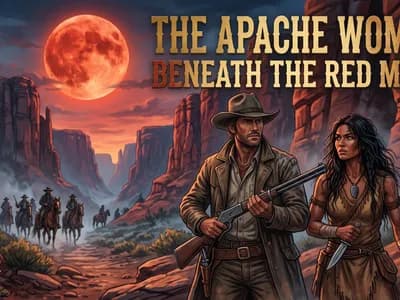
A Lonely Cowboy Freed an Apache Woman From Chains—But the Secret She Carried Could Destroy the Richest Man in Town
Chapter 9 • Part 9/9 • ⏱ 4 min • 👁 2 • 22/11/2026
Theme
Font size19px
Chapter 9
Mara kept her father's compass on the desk, not as a relic but as a working instrument. Caleb found that he could speak more easily when teaching a child to saddle a horse than when talking to a crowd. Their affection grew without any promise that one of them had to become a different person. He loved the way she asked questions nobody else dared to ask. She loved that he made room for answers he did not yet understand. The ranch was no longer a hiding place. It was a place people came to begin again.
They rebuilt the ranch together. Not the same house. A better one. Mara designed the windows. Caleb built the porch. The ranch became a stopping place for travelers. Then a school. Then a small water office. People came to learn surveying. Children learned that water belonged to everyone. Caleb still spoke little. Mara spoke more. They balanced each other. One evening, Mara found Caleb sitting beneath the porch. She handed him a letter. "What is it?" "From the governor." Caleb opened it. The new administration wanted him to become territorial marshal. Mara smiled. "You'd be good at it." "No." She laughed. "Why not?" "I like fences."
"You're afraid of the law?" "I'm afraid of paperwork." Mara laughed. It was the first time Caleb had heard her laugh freely. He smiled. Then he looked at the sunset. "Anna would have liked this." Mara sat beside him. "I think my father would have too." They sat quietly. After a while, Mara said: "Do you regret helping me?" Caleb turned toward her. "No." "Even after everything?" "Especially after everything." She looked at him. "Why?" Caleb thought for a long time. Then he answered: "Because you reminded me that a person can lose almost everything and still choose what comes next." Mara smiled. "And you?"
"I was reminded too." The wind moved through the grass. Neither needed to say anything else.
Long afterward, the people of Devil's Creek disagreed about the moment their history had changed. Some said it began when Caleb tore a false contract on a railway platform. Others chose the day Mara spoke at Mercy Ridge, or the morning the river broke through the valley and filled the old irrigation ditches. Ruth believed the turning point came when the first frightened witness put a name beneath a statement. Caleb had his own answer, though he rarely offered it. He remembered Mara standing in the doorway of his spare room, checking whether the lock worked from the inside. That small movement told him what freedom had to mean. It was not a favor given by the powerful, nor a debt owed to the rescuer. It was the right to make a choice and live with its consequences. The river flowed past the rebuilt ranch, sometimes low and sometimes fierce, never perfectly obedient to the lines on a map. Children learned to measure it, farmers learned to share it, and travelers learned the names of those who had protected it. Mara never forgot the irons on her wrists. She simply refused to let them be the final image of her life. When Caleb asked if she was ready to ride north, she answered before he finished the question. There were still valleys to see and people to meet. Their home would be waiting when they returned.
Years later, travelers still told stories about Devil's Creek. They told stories about Silas Crowley. About the hidden river. About the governor who lost his office. About the rancher who refused to draw first blood. But the story Mara remembered was different. She remembered the train station. The iron around her wrists. The crowd. The men who looked at her as though she were something that could be owned. And she remembered a quiet rancher walking through them. He hadn't saved her life. She had saved herself. He had simply given her something she needed desperately. A choice. Mara stood on the porch of the rebuilt ranch one autumn morning.
Below her, the river moved through the valley. Children rode horses near the school. Farmers worked the fields. The water belonged to everyone. Caleb approached with two horses. "Ready?" Mara smiled. "Where?" "North." "Why?" "There's another valley." She laughed. "Are you looking for trouble?" "Probably." She mounted. They rode together beyond the ranch. The road climbed toward the mountains. Mara looked back once. The ranch was small against the enormous desert. But it was home. Not because someone had given it to her. Because she had helped build it. Caleb rode beside her. After several miles, Mara asked: "Do you still think silence is the best way to live?"
Caleb considered the question. "No." "What changed?" He looked at her. "Sometimes you have to speak." "And sometimes?" He smiled. "Sometimes you just ride." They continued toward the mountains. Behind them, Devil's Creek carried on without fear. The river ran freely. The ranches remained independent. And the people remembered what had happened. Not as the story of a helpless woman rescued by a silent cowboy. But as the story of a woman who refused to disappear. And a rancher who understood that helping someone did not mean owning their future. It meant standing beside them until they could choose it themselves. The sun climbed over the mountains.
Mara pulled her hat lower. Caleb urged his horse forward. Two riders disappeared into the golden horizon. And somewhere behind them, the river kept moving. Free. Just like the woman who had once been brought to Devil's Creek in chains. Just like the man who had walked into a crowd and refused to let them decide what another human being was worth. Their story ended there. But the road did not. The road never does.
Disclaimer: This story is a work of fiction created for entertainment purposes. Any resemblance to real people, events, organizations, or places is purely coincidental.
More in the same category
View more →