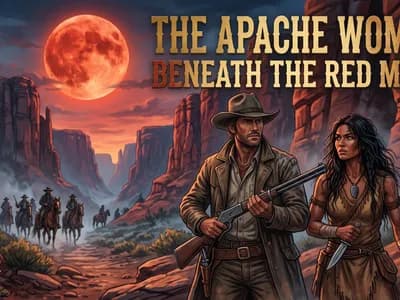
A Lonely Cowboy Freed an Apache Woman From Chains—But the Secret She Carried Could Destroy the Richest Man in Town
Chapter 6 • Part 6/9 • ⏱ 4 min • 👁 2 • 22/11/2026
Theme
Font size19px
Chapter 6
Ruth had kept the carbon copies because she knew a clean sheet of paper could be made to lie. She also knew the original ledger might be lost. Together the three of them compared the names on Mara's surviving page with the signatures on Ruth's documents. They found a sequence of payments matching arrests, foreclosures, and deaths. Caleb wanted to ride straight to the capital. Ruth insisted they needed witnesses who would testify under oath. Mara agreed. For the first time, she felt less like a fugitive carrying a secret and more like a surveyor assembling proof. A map required more than one measurement. So did justice.
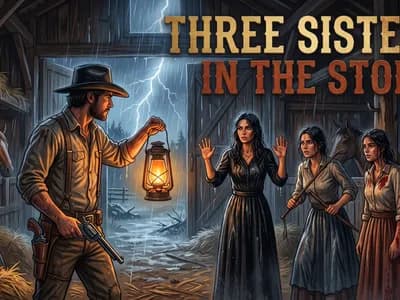
They reached Devil's Creek three days later. The town had changed. Crowley's men stood on every corner. The courthouse was guarded. The bank refused Caleb's account. Even the church had been pressured to deny them shelter. Mara realized how powerful Crowley had become. Then she remembered the page. They needed to reach the governor. But the governor was three hundred miles away. And Crowley knew they were coming. That night, Caleb and Mara hid inside an abandoned stable. A woman found them. Her name was Ruth Bell. She had worked in Crowley's office. She carried a bundle of documents. "I can help." Caleb raised his rifle.
"Why?" Ruth answered: "Because my husband disappeared too." She showed them a letter. Crowley had ordered his arrest after he refused to falsify a land deed. Ruth had stolen copies of the orders. Mara looked at the documents. They connected Crowley directly to the governor. "Why didn't you go to the authorities?" Ruth laughed bitterly. "I did." "And?" "They told me to forget." Caleb looked at Mara. "We ride tonight." They left Devil's Creek before midnight. Crowley's men followed. The chase lasted until dawn. At a narrow bridge, Caleb stopped. Mara stared at him. "What are you doing?" "Buying us time." He handed her the documents.
"Go." "No." "Mara." "No." He looked at her. For the first time, his calm expression cracked. "If they catch us, none of this matters." Mara shook her head. "We started this together." Then she smiled. "So we finish it together." They crossed the bridge. Behind them, Crowley's riders appeared. Caleb turned. Mara raised her rifle. The first shot echoed through the canyon.
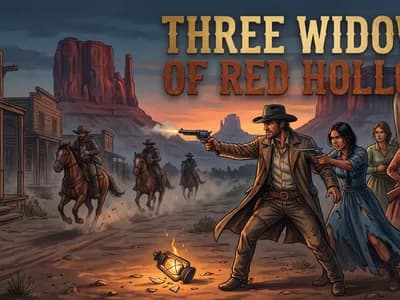
The bridge was a narrow timber span above a dry gorge, built for freight wagons rather than men exchanging gunfire. Caleb chose it because the cliffs protected their flanks. He positioned the horses behind a boulder and warned Mara not to waste ammunition on shadows. She ignored his attempt to send her ahead, but she listened to the rest. When Crowley's riders appeared, the first shot struck a railing. Splinters flew. Mara fired at a saddlebag to make one horse shy, and the sudden confusion stopped the charge. Caleb wounded a rider's arm, forcing the others to take cover. The fight was ugly and uncertain, nothing like the neat duels described in cheap newspapers. A bullet caught Caleb high in the shoulder. He fell against the bridge post, and Mara felt the world narrow to the red spreading across his shirt. Then she remembered his instruction: do the next useful thing. She pulled him behind stone, tied a strip of her scarf over the wound, and kept her rifle trained on the approach. Ruth, who had taken the documents ahead, returned with two farmers from the next settlement. Their arrival made Crowley's men retreat. Caleb protested that Ruth had risked the papers. She told him she had made copies before leaving. Mara laughed through exhaustion. It was the first time their enemies had been defeated by preparation rather than luck.
The battle at the bridge lasted twenty minutes. When it ended, Crowley's riders had retreated. Caleb had been wounded in the shoulder. Mara wanted to stop. He refused. "We keep moving."
Mercy Ridge was no paradise. Its people argued over grazing boundaries and complained about the cost of flour. But the schoolteacher, Miss Ada Finch, believed that public records belonged to the public, and the blacksmith had lost a brother to a suspicious mine collapse. They gave Mara a table in the schoolhouse and asked her to explain the map. She drew the mountains in chalk, then the hidden channels, then the ranches whose wells had failed after Crowley bought neighboring land. Children crowded around the doorway, fascinated by the idea of a river running beneath their feet. Their parents understood the darker meaning. If Crowley could close the gates, he could demand a fee for the water that kept their fields alive. Ada brought paper and ink, and the townspeople copied the evidence in teams. One copy went north with a stage driver, another east with a traveling minister, another to a newspaper editor who had been waiting for a story he could prove. Mara signed each account with her full name. She had been denied even that at the train station. Now her name traveled farther than Crowley's threats. When she addressed the crowd, she did not ask them to worship her courage. She asked them to remember their own. The first witness stepped forward, and then another. By nightfall the schoolhouse walls were lined with statements.
They reached a small settlement by sunset. The town was called Mercy Ridge. The people there had also suffered under Crowley. When they learned who Mara was, they opened their homes. For the first time, she saw something she hadn't seen in Devil's Creek. People willing to stand together. A blacksmith offered horses. A farmer offered food. The schoolteacher copied the documents. The preacher sent riders north. Within two days, copies of Crowley's records were spreading across the territory. Crowley could no longer destroy every copy. But he had one final weapon. He announced that Mara was wanted for murder. A false accusation. The town became divided.
Disclaimer: This story is a work of fiction created for entertainment purposes. Any resemblance to real people, events, organizations, or places is purely coincidental.
More in the same category
View more →